


Choosing a Nearshore model is only the first step. In many cases, the real difference is not defined by the model itself, but by the provider you choose and the type of relationship you build.
A Nearshore provider can limit itself to filling roles, or it can integrate as a true extension of your team, bringing technical judgment, business understanding, and sustained execution capacity. That difference directly impacts product quality, delivery speed, and the predictability of growth. For that reason, identifying the right partner is a strategic decision, not an operational one.
Choosing well means looking beyond available talent. It requires evaluating track record, ways of working, integration capability, and how the provider approaches long-term technology decisions. Not all providers position themselves in the same way, and understanding these differences is key to reducing risk and maximizing the value of the Nearshore model.
This is the approach Giga IT takes: operating as a Nearshore partner with more than 15 years of experience, integrating into clients’ teams and supporting technology decisions aligned with business goals. Our model is built on clear processes, continuous communication, and a structured way of working that begins with understanding context and is sustained throughout execution.
This approach is reflected both in how we work and in the experiences shared by clients on independent review platforms such as Clutch, where real references from companies already working under this collaboration model are available.
Independent client reviews and long-term collaboration cases reinforce this positioning. Platforms like Clutch, where Giga IT has an active and validated profile, make it possible to access real experiences from companies that already operate under this model.
Clearly define your needs
Before you start searching, look inward. A deep understanding of your own requirements is essential. Consider the following:
- Specific technical skills: What technologies, programming languages, and platforms do you need? Be as specific as possible.
- Roles and responsibilities: Do you need backend developers, DevOps engineers, UX/UI designers, or a full team?
- Team size: How many people do you need to add?
- Project duration: Is this a short-term project or a long-term collaboration?
- Culture and methodology: Culture and methodology: Do you work with Agile, Scrum, or Kanban? What is your company culture? The provider must be compatible.
Research and shortlist providers
Once you understand what you are looking for, it is time to explore the market. Do not limit yourself to a superficial Google search.
- Review platforms: Use sites such as Clutch.co, GoodFirms, and G2 to read verified client reviews.
- Professional networks: Use LinkedIn to review employee experience and the types of projects they have worked on.
- Case studies: Review case studies and portfolios on providers’ websites. Do they have experience in your industry or in similar projects?
- Geographic location: Research talent hubs in Latin America. Countries such as Colombia, Argentina, Mexico, and Brazil have mature technology ecosystems.
Key evaluation criteria
When engaging with shortlisted providers, evaluate them based on the following criteria:
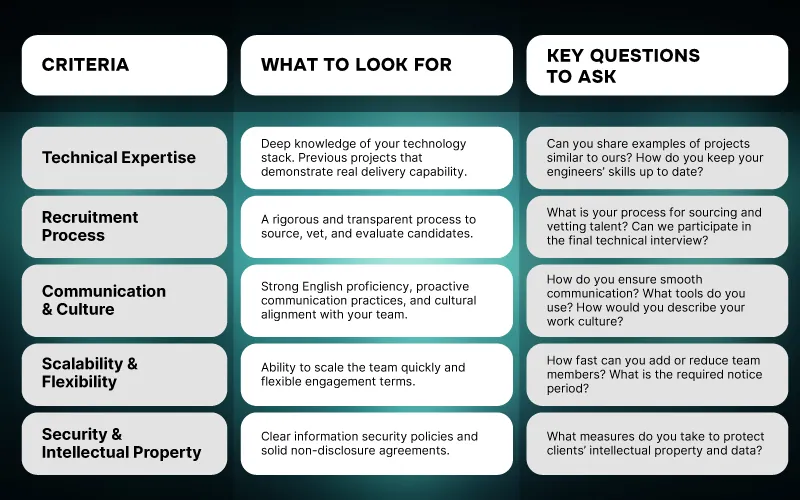
Beyond the listed technologies, it is critical to understand how each provider positions itself: as a task executor, a delivery partner, or a strategic technology partner.
Interview and selection process
Do not rely solely on promises made by the sales team. The key is validating the quality of the talent.
- Interview candidates: Request interviews with the developers who may join your team. This is a standard practice in the Staff Augmentation model.
- Technical assessments: Conduct live coding interviews or small test projects to evaluate practical skills.
- Reference checks: Ask to speak with current or former clients to gain an honest perspective on their experience working with the provider.
Conclusion
Choosing a Nearshore provider is not an operational decision or a simple cost comparison. It is a choice that directly impacts how a company builds, scales, and sustains its technology capabilities over time.
Beyond access to qualified talent, what truly defines the value of the Nearshore model is the type of relationship that is established. When there is business understanding, clear processes, and transparent collaboration, the provider stops being a third party and becomes a true extension of the internal team.
At that point, Nearshore stops being just an efficient alternative and becomes an enabler of predictable growth, with a focus on outcomes and technology decisions aligned with the business.
Frequently Asked Questions (FAQ)
Q: What is more important, cost or quality?
A: While cost is a factor, quality and cultural compatibility are far more important in the long term. A low-cost, low-quality developer can end up costing more through delays, errors, and rework. Focus on value for money, not the lowest price.
Q: Should I sign a long-term contract from the beginning?
A: It is not recommended. A strong provider will offer a trial period or a shorter initial engagement (for example, three months) to ensure the collaboration works for both parties before committing to a long-term agreement.
Q: What red flags should I watch for?
A: Be cautious of providers that do not allow you to interview developers, lack a clear recruitment process, offer suspiciously low pricing, or are not transparent about how they operate.
Q: Why choose Giga IT as a Nearshore partner instead of another provider?
A: Giga IT combines senior talent, cultural alignment, and proven experience to truly integrate into client teams. We do not operate as a traditional external vendor, but as a technology partner embedded in the client’s teams and processes.
- 15+ years of software development experience
- 300+ senior engineers across LATAM
- Presence in 30+ countries
- 99% client retention rate



0 Comments