
Staff Augmentation vs Managed Services: Differences, Costs and How to Choose

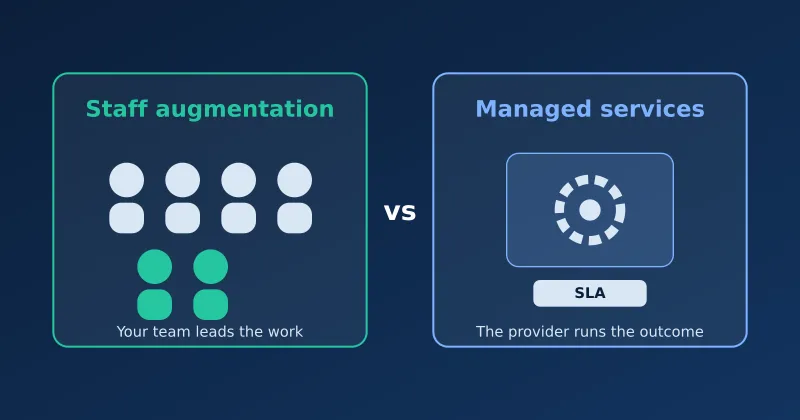
Short answer: staff augmentation adds external engineers to your team, and your managers direct their work; you buy capacity. Managed services hand a function or an outcome, such as infrastructure operations, application support or a help desk, to a provider that runs it under a service agreement; you buy a result. Choose staff augmentation when the work is core to your product and you have the leadership to direct it. Choose managed services when the function is stable, well defined and you would rather buy a service level than manage people.
Related: staff augmentation services · IT staffing agency · hire dedicated developers
What is staff augmentation?
Staff augmentation is a hiring model in which you add external professionals to your own team for as long as you need them. They follow your processes, use your tools and report to your managers, while the provider handles recruiting, contracts, payroll and continuity. You keep control of priorities, architecture and quality.
It works when you already have technical leadership and a roadmap, but not enough people to deliver it: a backlog that keeps growing, a skill your team lacks, such as MLOps or test automation, or a peak of work that does not justify permanent hires.
What are managed services?
In a managed services model you transfer responsibility for a function to a provider. Instead of people, you contract an outcome: systems that stay available, tickets resolved within an agreed time, an application kept patched and monitored. The provider decides how many people it needs and how they work, and it answers for the result through a service level agreement (SLA).
Typical managed IT services include infrastructure and cloud operations, network and security monitoring, help desk, application maintenance and support, and managed testing. They fit functions that are repetitive, measurable and not where your product competes.
Staff augmentation vs managed services: side-by-side comparison
| Staff augmentation | Managed services | |
|---|---|---|
| What you buy | Engineering capacity by role and seniority | An outcome or a function, measured by SLAs |
| Who directs the work | Your managers and tech leads | The provider |
| Who is accountable for results | Your team | The provider, within the agreed scope |
| Typical pricing model | Per person, by time | Recurring fee tied to scope and service levels |
| Flexibility | Add or remove people as the roadmap changes | Changes go through the service agreement |
| Knowledge retention | Stays in your team and repositories | Largely with the provider, unless handover is contracted |
| Management effort for you | Higher: you lead the people | Lower: you manage the provider and the SLA |
| Best for | Product development and work that is core to your business | Stable, well-defined operations that are not core |
When to choose staff augmentation
- The work is core to your product. If the code and the decisions define how you compete, keep them inside a team you lead.
- You have leadership but not enough people. Tech leads and a roadmap exist; the bottleneck is hands and specific skills.
- Requirements change often. Agile product work is hard to freeze into an SLA; augmented engineers follow your sprint priorities.
- You want the knowledge to stay. Architecture, domain knowledge and code remain with your team when the engagement ends.
For U.S. companies, nearshore staff augmentation from Latin America adds one more advantage: engineers share most of your working day, so they join stand-ups, code reviews and incidents in real time. See nearshore staff augmentation services or, for contract roles, our IT staffing agency page.
When to choose managed services
- The function is stable and measurable. Uptime, response times and ticket resolution translate cleanly into SLAs.
- It is not where you compete. Running it in-house takes leadership attention away from the product.
- You want predictable spend. A recurring fee tied to scope is easier to budget than a changing team.
- You lack the management layer. If nobody internally can lead the people, buying an outcome is safer than buying capacity.
If this is your case, see how our managed IT services run critical systems with AIOps. The trade-off is control. You depend on the provider’s processes, changes take negotiation, and switching providers later requires a documented handover.
Combining both models
Many companies use both at the same time: managed services for stable operations such as infrastructure or support, and staff augmentation for the product roadmap. Another common path is to start with augmented engineers while a function is still changing, then move it to a managed model once it is stable and well documented. The rule is simple: give each engagement one clear owner and avoid splitting a single system between two providers without explicit boundaries.
If you need something in between, a team that owns a product area while you keep the roadmap, look at a dedicated development team: a squad with its own tech lead and QA that works only on your product. For the broader comparison with project outsourcing, read staff augmentation vs outsourcing.
What drives cost in each model
Comparing hourly rates against a monthly fee is misleading. In staff augmentation, total cost is the engineers plus the time your leads spend directing them, so it rewards teams that already have strong leadership. In managed services, the fee includes the provider’s management, tooling and the risk it takes on to meet the SLA, so it rewards well-defined scopes. In both, the hidden costs are the same: onboarding, turnover, rework and an unplanned exit.
Questions to ask a provider before you sign
| Question | Why it matters |
|---|---|
| Will I interview and approve every engineer? | In staff augmentation, the people are the product. |
| How much of my working day will the team overlap? | Overlap decides whether issues are solved the same day or the next. |
| What happens if someone leaves? | Continuity and replacement terms protect delivery. |
| Which SLAs apply, and what happens when they are missed? | In managed services, the SLA is the contract you actually manage. |
| Who owns the code, the documentation and the operational knowledge? | IP and handover terms decide how hard it is to change providers. |
| Who do I sign with, and in which country? | Contract law, billing and data rules depend on it. |
How GIGA IT works
GIGA IT works in both models. With staff augmentation services and dedicated development teams, senior, AI-augmented engineers from Latin America join your team in U.S. time zones. With our managed IT services, an AI-augmented team monitors and runs your systems with AIOps. You contract with GIGA IT LLC, a U.S. company with its legal address in Houston, Texas. Since 2008 we have worked with 50+ clients in 15 countries, with 300+ specialists, 1,215+ projects and 97% client retention.
Frequently asked questions
What is the difference between staff augmentation and managed services?
Who directs the work and what you pay for. With staff augmentation you add engineers to your team and your leads direct them; you pay for capacity. With managed services a provider takes over a function or outcome and runs it under a service agreement; you pay for the result.
Is staff augmentation cheaper than managed services?
Not by default. Staff augmentation is usually billed by person, so cost follows the capacity you use and your own management time. Managed services are usually a recurring fee tied to scope and service levels, which gives predictability but includes the provider’s management and risk. Compare total cost, not the rate.
When should I choose managed services instead of staff augmentation?
When the function is stable, well defined and not core to your product, such as infrastructure monitoring, help desk or application support, and you would rather buy a service level than manage people.
When is staff augmentation the better choice?
When you have technical leadership and a roadmap but not enough engineers, when a skill is missing for a period, or when the work is core to your product and you want the knowledge to stay in your team.
Can I combine staff augmentation and managed services?
Yes. A common pattern is managed services for stable operations and staff augmentation for the product roadmap. Give each engagement a clear owner and avoid splitting one system between two providers without clear boundaries.
Who owns the code and the knowledge in each model?
In staff augmentation the code lives in your repositories and the knowledge stays in your team, but confirm IP assignment in the contract. In managed services the provider holds much of the operational knowledge, so contract documentation and an exit plan from day one.
Sources
- Deloitte, Global Outsourcing Survey.
- U.S. Copyright Office, Circular 30: Works Made for Hire.
Keep reading

Nearshore· 7 min read
How to Hire a Dedicated Development Team: A Buyer’s Guide for U.S. Companies
Eduardo Gonzalez · CEO

How to hire a dedicated development team: when it beats staff augmentation or a fixed-scope project, how to vet providers, contract terms and AI governance.

Nearshore· 8 min read
Staff Augmentation vs Outsourcing: How to Choose (and When to Use Both)
Santiago Alcain · Founder & President

Staff augmentation adds engineers to your team under your leadership; outsourcing hands a defined scope to a vendor that owns the result. Insights from GIGA IT.

Nearshore· 11 min read
Top Nearshore Trends to Watch in 2024 and Beyond: Navigating the Shifting Outsourcing Landscape
Santiago Alcain · Founder & President
If you’re planning to leverage nearshore IT outsourcing, it’s imperative to be aware of the “nearshore trends to watch in 2024 and beyond”. GIGA IT guide.