Operate Production Systems with AI-Augmented Reliability
GIGA IT provides Artificial Intelligence augmented managed services that monitor infrastructure, detect anomalies,and prioritize incidents across complex environments, improving reliability, visibility, and response times in mission-critical operations.
Trusted in mission-critical environments






Identify Operational Risks Before Incidents Impact the Business
We evaluate your infrastructure, applications, observability stack, operational processes, and historical incident patterns to identify risks that threaten operational continuity.
Our assessment reveals where outages originate, how signal noise affects response times, and what is required to evolve from reactive support to predictive, AI-driven operations.

Architecture & Systems Assessment
We analyze infrastructure, applications, integrations, and failure points across cloud, hybrid, and on-prem environments.

Observability & Telemetry Review
We evaluate logs, metrics, traces, and monitoring tools to identify visibility gaps and signal quality issues.

Incident Patterns & SLA Baseline
We analyze recurring incidents, MTTA/MTTR trends, operational bottlenecks, and escalation patterns.

Performance & Capacity Analysis
We assess system load behavior, latency thresholds, scaling limits, and resource inefficiencies.

Security & Compliance Alignment
We validate access controls, audit requirements, and dependencies between operations, security posture, and compliance frameworks.

Readiness & Risk Report
We deliver a clear analysis of operational maturity, infrastructure risks, and the roadmap required to implement AI-augmented operations.
Design a Predictive Operating Model Powered by AI
Operate Critical Systems with Predictive Intelligence
Assess
Identify Operational Risks Before Incidents Impact the Business
We evaluate your infrastructure, applications, observability stack, operational processes, and historical incident patterns to identify risks that threaten operational continuity.
Our assessment reveals where outages originate, how signal noise affects response times, and what is required to evolve from reactive support to predictive, AI-driven operations.
Architecture & Systems Assessment
We analyze infrastructure, applications, integrations, and failure points across cloud, hybrid, and on-prem environments.
Observability & Telemetry Review
We evaluate logs, metrics, traces, and monitoring tools to identify visibility gaps and signal quality issues.
Incident Patterns & SLA Baseline
We analyze recurring incidents, MTTA/MTTR trends, operational bottlenecks, and escalation patterns.
Performance & Capacity Analysis
We assess system load behavior, latency thresholds, scaling limits, and resource inefficiencies.
Security & Compliance Alignment
We validate access controls, audit requirements, and dependencies between operations, security posture, and compliance frameworks.
Readiness & Risk Report
We deliver a clear analysis of operational maturity, infrastructure risks, and the roadmap required to implement AI-augmented operations.
Design
Design a Predictive Operating Model Powered by AI
Deliver
Operate Critical Systems with Predictive Intelligence
Technologies we use





Turn on the transformation
Operations Built to Execute at Real Scale
Managed services matter only if they survive real constraints in mission-critical environments. GIGA IT combines executive consulting with production-grade Artificial Intelligence engineering to deliver operational frameworks built for ROI, reliability, and compliance.
Projects Delivered
Years in Complex Systems
Client Retention
Engineering Specialists

PRODUCTION-READY DECISIONS
GIGA IT validates priorities against data readiness, integrations, SLAs, and governance, so execution won’t stall in production.
EXECUTIVE ALIGNMENT
Decision workshops align stakeholders on what to fund first, reducing friction and accelerating time-to-value with clear ownership.
FROM ROADMAP TO DELIVERY
Execute with your team, with our AI Engineering Teams, or via end-to-end delivery fast, accountable, and low-risk.
Measured Outcomes in Complex Production Environments

 INDUSTRY
 WHAT WAS AT STAKE
 WHAT WE DID
 BUSINESS IMPACT
» GIGA IT enables AI-augmented operations, so enterprises improve reliability, response times, and visibility.
FAQ | IA – Augmented Managed Services
What Are AI‑Augmented Managed Services?
GIGA IT’s AI-Augmented Managed Services are operational services for production environments where reliability, visibility, and fast incident response are critical. They combine observability, Artificial Intelligence-based anomaly detection, intelligent incident management, automated remediation, and continuous optimization.
How Is This Different from Traditional IT Monitoring?
Traditional monitoring reacts after failures. GIGA IT’s Artificial Intelligence-augmented operations detect anomalies early, correlate signals across systems, reduce alert noise, and prioritize incidents automatically, enabling proactive response and reducing MTTR across mission-critical environments.
What Do We Deliver at the End of an Engagement?
GIGA IT delivers a fully operational, production-grade managed service: 24/7 monitoring of critical systems, AI-powered anomaly detection, automated remediation, observability dashboards, runbooks and incident workflows, plus SLAs, KPIs, and executive reporting.
How Does GIGA IT Ensure Reliability and Compliance?
GIGA IT builds operations on observability, audit trails, access controls, encryption, compliance checks, HA/DR strategies, and defined SLO frameworks. All operational actions are logged, traceable, and aligned with regulatory standards across cloud, hybrid, and on-prem.
What Delivery Models Are Available?
GIGA IT delivers AI-Augmented Managed Services through three models, all nearshore and time-zone aligned with SLAs and reporting: End-to-End Delivery for full ownership, AI Engineering Teams as cross-functional units, or Staff Augmentation with senior specialists..
Can the Environment Continue Improving Over Time?
Yes. GIGA IT provides continuous improvement including capacity planning, performance tuning, FinOps optimization, runbook automation, and root-cause analysis. The objective is to compound reliability over time, not just maintaining the status quo.
Data science is used to study data in four main ways:
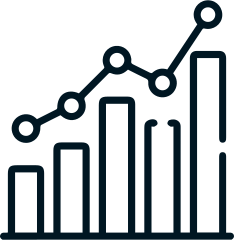
Descriptive Analysis
Descriptive analysis examines data to gain insights into what has happened or is happening in the data environment. It is characterized by data visualizations such as pie charts, bar or line graphs, tables, or generated narratives. For example, a flight booking service records data such as the number of tickets booked each day. Descriptive analysis will reveal peaks and dips in bookings, as well as months of high service performance.
Diagnostic Analysis
Diagnostic analysis is a deep or detailed examination of data to understand why something has occurred. It is characterized by techniques such as detailed analysis, data discovery and mining, or correlations. Various data operations and transformations can be performed on a given dataset to discover unique patterns in each of these techniques. For example, the flight service could perform detailed analysis of a month with particularly high performance to better understand the booking peak. This may reveal that many customers visit a specific city to attend a monthly sports event.

Predictive Analysis
Predictive analysis uses historical data to make accurate forecasts about data patterns that may occur in the future. It is characterized by techniques such as machine learning, forecasting, pattern matching, and predictive modeling. In each of these techniques, computers are trained to reverse-engineer causality connections in the data. For example, the flight services team could use data science to predict flight booking patterns for the next year at the beginning of each year. The computer program or algorithm can examine past data and predict booking peaks for certain destinations in May. By anticipating future travel needs of customers, the company could begin specific advertising for those cities as early as February.
Prescriptive Analysis
Prescriptive analysis takes predictive data to the next level. It not only predicts what is likely to happen but also suggests an optimal response to that outcome. It can analyze the potential implications of different alternatives and recommend the best course of action. It uses graph analysis, simulation, complex event processing, neural networks, and machine learning recommendation engines. Going back to the flight booking example, prescriptive analysis could examine historical marketing campaigns to maximize the advantage of the upcoming booking peak. A data scientist could project the results of bookings from different levels of spending on various marketing channels. These data forecasts give the flight booking company greater confidence in its marketing decisions.
Don’t fall behind on the latest in AI

Business
How to choose the right nearshore partner: A strategic guide
Choosing a Nearshore model is only the first step. In many cases, the real difference is not defined by the model itself, but by the provider you choose and the type of relationship you build.

Nearshore
Nearshore vs. Offshore: Which outsourcing model is best for your business?
Once a company decides to outsource part of its operations, the next critical question is: where? The location of the service provider has a sig nificant impact on communication, costs, and collaboration.

Nearshore
5 Clear signs your company needs Staff Augmentation
Is your development team overloaded? Are project timelines constantly slipping? Are you struggling to find talent with highly specialized skills? These challenges are common across the technology sector.