


Once a company decides to outsource part of its operations, the next critical question is: where? The location of the service provider has a sig nificant impact on communication, costs, and collaboration. The two most common geo graphic outsourcing models are Nearshore and Offshore.. Understanding their nuances is essential to building a successful outsourcing strategy.
What is Nearshore?
The Nearshore model involves delegating tasks or projects to companies located in geographically close countries with similar time zones. For a company based in the United States, the most common Nearshore destinations are Latin American countries such as Mexico, Colombia, or Argentina. Geo graphic and cultural proximity is the primary differentiator of this model. Nearshore makes it possible to work as if the external team were a natural extension of the internal team, reducing operational friction and accelerating decision-making.
Key Definition: Nearshore refers to outsourcing services to a nearby country, typically within the same region and with minimal time zone differences (usually 0 to 3 hours).
Advantages of Nearshore
- Aligned time zones: Enable real-time collaboration, meetings, and smoother communication between teams.
- Cultural alignment: Similar work practices and cultural norms reduce communication barriers and improve team integration.
- Ease of travel: Geographic proximity allows for faster, more affordable in-person visits, strengthening the client–provider relationship.
- Skilled talent: Regions such as Latin America offer a growing ecosystem of highly qualified technology talent.
What is Offshore?
Offshore, on the other hand, refersto outsourcing services to distant countries, often located on different continents. For companies in Europe or North America, traditional Offshore destinations include countries such as India, the Philippines, or Ukraine. Historically, the main appeal of the Off shore model has been cost reduction.
Key Definition: Offshore involves outsourcing to a distant country, which typically results in significant time zone differences (usually 8 to 12 hours).
Advantages of Offshore
- Lower labor costs: Often the most economical option in terms of hourly rates.
- Access to a large talent pool: Countries such as India have a vast population of IT professionals.
24/7 operations: Time zone differences can be leveraged to create a continuous work cycle (the “follow-the-sun” model), allowing work to continue outside the client’s standard business hours.
Comparison: Nearshore vs. Offshore
The choice between Nearshore and Offshore depends on your project’s priorities. Below is a direct comparison:
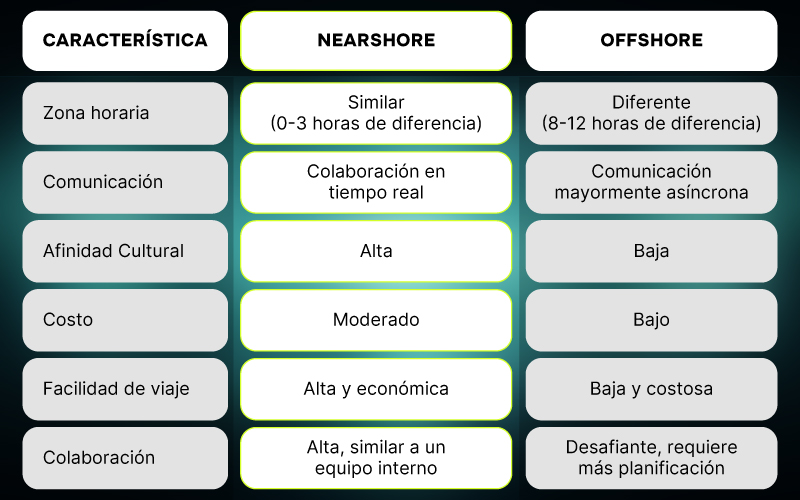
Conclusion
The decision between Nearshore and Offshore goes beyond hourly rates. While Offshore may appear attractive in terms of initial pricing, Nearshore delivers greater agility, stronger communication, and lower operational friction. For companies looking to scale without losing control, accelerate innovation, and work with truly integrated teams, Nearshore is a strategically sound choice. At Giga IT, we support companies throughout this process, helping them select and execute the Nearshore model in a strategic way. Learn how we can support you as your Nearshore partner.
Frequently Asked Questions (FAQ)
Q: What is the main advantage of Nearshore over Offshore?
A: The primary advantage of Nearshore is real-time collaboration enabled by aligned time zones. This allows for more agile communication, faster problem resolution, and closer integration with the internal team.
Why choose a Nearshore partner like Giga IT?
R: Not all Nearshore providers are the same. The real difference lies in how the model is executed.
At Giga IT, we operate as strategic partners, not as simple service providers.
Our clients benefit from:
- Nearshore teams aligned with their business goals, not just a technology stack.
- Direct and continuous communication, with shared technical and operational leadership.
- Flexibility to scale teams based on project demand (staff augmentation and project-based delivery).
- A focus on outcomes, not billable hours.
- Experience across multiple industries, from technology and fintech to e-commerce and enterprise solutions.
Our approach is built on a clear way of working and proven processes that allow us to integrate seamlessly into our clients’ teams.
Q: Is Offshore always cheaper than Nearshore?A: While hourly rates in Offshore destinations are often lower, the total cost of ownership (TCO) may not be. Hidden Offshore costs can in cludecosts can include increased management overhead, communication issues that cause delays, and higher travel expenses. Nearshore often delivers better value for money.
Q: Which model is better for Agile projects? A: Nearshore is generally better suited for Agile methodologies. Agile relies on constant communication, daily collaboration, and the ability to pivot quickly, all of which are facilitated by Nearshore’s time zone and cultural proximity.
Q: What types of projects are best suited for Offshore? A: Offshore can be a good option for projects with very stable, well-documented requirements, where the need for real-time communication is minimal.



0 Comments